

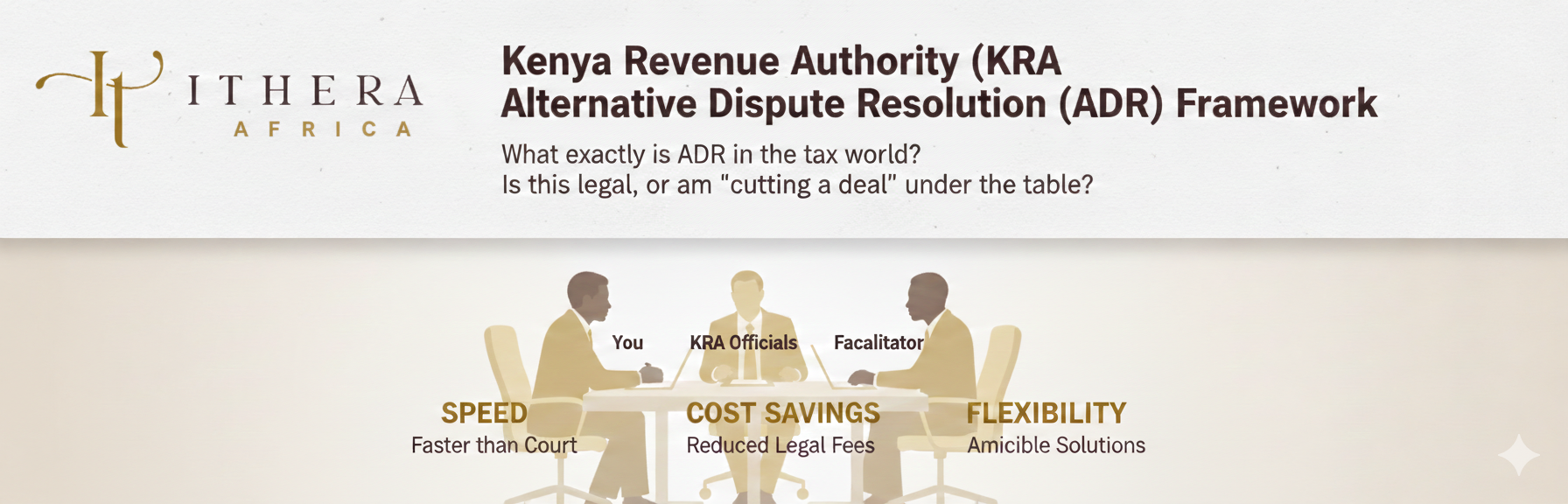
- What exactly is ADR in the tax world?
Think of it as a sit-down meeting between you and KRA. You get to iron out tax disagreements. It’s an alternative to going to court or the Tax Appeals Tribunal.
- Is this legal, or am I “cutting a deal” under the table?
It is completely legal. Kenyan laws including the Constitution actually encourages ADR, granting KRA the power to settle disputes outside of court. It is a formal process guided by official regulations and backed by the law.
- How does it actually work?
It is more of a facilitated mediation.
Who?
- The Parties: You (and your accountant/lawyer) and the KRA officials.
- The Facilitator: A neutral person who guides the conversation to ensure it is fair, confidential and efficient. They don’t pick a side; they just make sure the talk stays fair, confidential, and efficient.
How?
After formally challenging a tax assessment issued by the KRA, either party may opt to engage in ADR. Where ADR is pursued at the assessment stage, it must be concluded before the objection decision is issued. If the matter is before the Tribunal or a Court, ADR must be undertaken before Judgment is delivered.
Where ADR is initiated while a matter is pending before the Court or the Tribunal, the parties are required to formally notify the Court or Tribunal of their intention to resolve the dispute through ADR. The dispute must be settled within one hundred and twenty (120) days from the date of notification. Upon reaching a settlement, the parties must return to the Court or Tribunal to formally notify it of the agreed terms.
Why?
To agree on a settlement that works for both sides.
- Is the process foolproof?
Not entirely. Although ADR is relatively faster than going to Court or the Tax Appeals Tribunal, there has been criticism on the transparency of this process. This is mainly because of concerns around:
- Lack of judicial supervision: The Court or Tribunal’s role is only facilitative and not supervisory. This aspect introduces a risk of power imbalance.
- Because ADR meetings are strictly confidential and happen behind closed doors, they create a ‘black box’ risk. Without public or judicial oversight, this secrecy can hide unfair pressure or illegal deals, turning a private settlement into a risky encounter where the taxpayer lacks protection.
- Can all your tax problems be solved through ADR?
Almost. Most disputes qualify, but you CANNOT use ADR if:
- The case is about “interpreting the law” (meaning you’re disputing what the law means and not just how much you owe).
- You have been involved in tax-related fraud before.
- You already tried ADR for the same issue and failed.
- The settlement would be inconsistent with the Constitution or other laws.
- Are there any timelines to work with?
Yes.
- What are the benefits of choosing ADR?
- Speed: It’s much faster than the Tax Appeals Tribunal or the High Court.
- Cost: You save on heavy legal fees.